Have you ever had one of those moments where suddenly something you’re working on just... clicks? It’s such a satisfying feeling. My favourite is when I finally understand that thing a story is really about. A good story has only one. But you don’t always know what you're trying to say when you start: finding it takes work.
My recent AI talk is a good example of this (no video yet, soz). I worked on it in little bursts for months, presuming I had something to say about future of AI. I focussed on the mistakes we’re making at the moment: the misconceptions, the myths; trying to sort the hype from the doom.
When staring at the mess I'd made, I realised I wasn't writing about the future, but the past. The big hairy emergent idea was this: when we doom or hype a technology, we are destined to repeat the mistakes of the past.

I'd included lots of historical examples of where we gotten over-excited about a general purpose technology (the humble microwave!), preventing us from thinking clearly, hence the eventual title: General Purpose Turmoil: Why we’re confused by AI and what we should do about it.
It's a little painful, not knowing exactly what you're writing about while you're writing, and most people try to resolve that ambiguity too quickly. But I've done this enough times to know that by doing the work, a central idea will emerge. I just had to keep going.
And when that eureka moment arrives, the real beauty isn’t just the feeling you get: it’s that it allows you to refocus everything you’re saying around that one point, and cut the rest. You’re no longer reading out a shopping list: you've built a strong argument that leads in one direction, and everything has to earn its place in the direction of that argument.
I very deliberately did not use an LLM for anything other than research. I didn’t want its opinion about what I was trying to say. LLMs are really, really good at summarising and spotting themes in your work that you didn't even notice. But if you do that too soon, you'll be led by what it thinks, not you.
Even if you're not writing to find out what you're trying to say, you can still find the signal in the noise, it just takes a little work to abstract out the message.
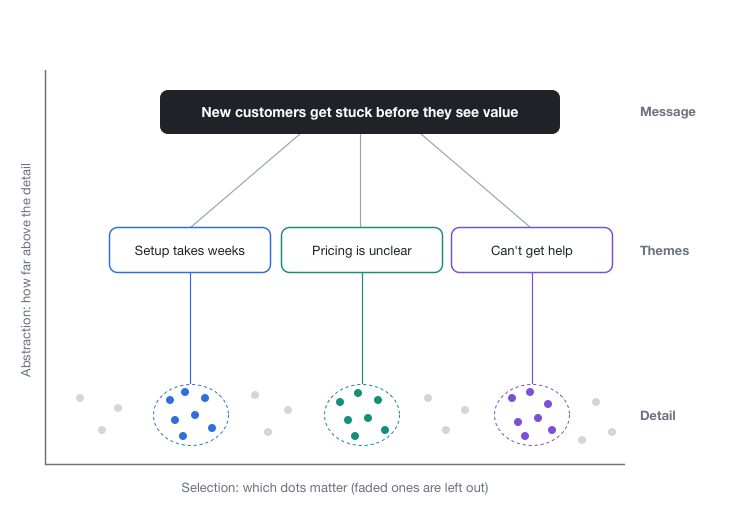
So... this week's advice. Don't ask an LLM what the theme is until after you've gathered your thoughts. And here's one way to do that:
Ask: what would a complete stranger say about this material? Not the title, or the stated subject, but the raw material. Look for a mismatch between what you think it's about, and what someone else would say.
A theme can often be spotted when you could cut the rest safely and it would still make sense as an argument.
If you'd spent a few minutes reading my AI talk while I was in the thick of it, you'd have spotted immediately that it wasn't focussed on the future, but on our past mistakes.
And in that moment, when you'd pointed it out to me, you'd have been my a-ha sniffing guide dog, finding the one thing I couldn't see myself.